

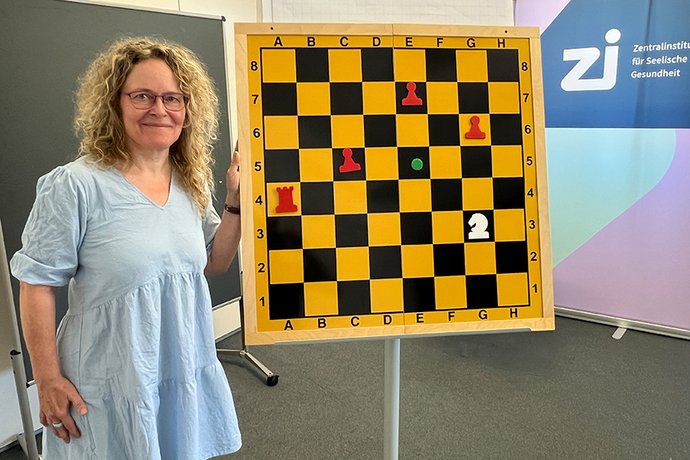
For several years, researchers at the Central Institute of Mental Health (CIMH) have been investigating whether chess-based cognitive training can also have therapeutic benefits. Two recent studies involving people with alcohol dependence, as well as children and adolescents with mental health conditions, now show that such training can improve quality of life and enhance cognitive abilities.
Chess Is of Interest to Psychiatric Research
Chess simultaneously requires attention, working memory, planning, impulse control, and problem-solving. For this reason, the CIMH, under the leadership of Prof. Dr. Sabine Vollstädt-Klein, has been investigating for several years whether chess-based cognitive training can effectively complement traditional psychotherapeutic and rehabilitative methods. It is precisely this combination that makes the approach so interesting for psychiatric research.
Unlike in traditional chess, competition and strategy are not the main focus in a therapeutic setting. Instead, participants specifically train their attention and memory by for example memorizing and reconstructing the pieces and their positions on the chessboard.
“Our goal is to develop therapy programs that are relevant to everyday life and effectively complement existing treatments. Chess offers interesting opportunities in this regard because it engages multiple cognitive functions simultaneously,” says Sabine Vollstädt-Klein, research group leader at the Clinic for Addictive Behavior and Addiction Medicine at the CIMH.
Greater attention and a higher quality of life
In a recent study, researchers at the CIMH investigated whether this approach could support the rehabilitation of people with alcohol dependence. In addition to their regular treatment, the participants underwent a structured training program involving chess problems.
It was found that the participants were able to better sustain their attention than the control group. At the same time, they reported a higher quality of life after the intervention compared to the control group. The results suggest that the training could help strengthen cognitive functions and subjective well-being during rehabilitation. In addition, the group training also fostered communication and social interaction during rehabilitation. Participants evaluated the intervention positively throughout. Their willingness to recommend the intervention to a friend actually increased significantly over the course of the study and remained at that higher level even three months after the intervention.
Similar effects are also seen in children and adolescents
A second study conducted by the CIMH with children and adolescents undergoing child and adolescent psychiatric treatment shows that chess-based cognitive training may also have potential in other areas of psychiatry. Over a period of six weeks, the adolescents, aged 13 to 17, participated in the training in addition to their regular therapy.
Here, too, the researchers observed positive effects: The adolescents showed improvements in their working memory performance and reported higher levels of psychological well-being and a better quality of life than the control group. The results suggest that the approach can not only enhance cognitive abilities but also positively influence patients’ subjective experience.
“Our goal is not to replace established therapies with chess-based training. As an easily accessible and practical option, it can serve as a useful supplement,” says Sabine Vollstädt-Klein.
Why Quality of Life Is So Important
It is noteworthy that similar effects were observed in two very different patient groups—those with alcohol dependence and those with mental illnesses in adolescence. In both cases, aspects of quality of life improved. This is a key therapeutic goal for people with mental illness, as it is crucial to how well those affected can manage their daily lives, build social relationships, or reengage in social life. In addition, specific cognitive functions also improved.
The findings to date come from pilot studies. Now, the researchers want to conduct larger studies to determine which patient groups benefit the most and how chess-based training could be integrated into existing treatment approaches in the future. “If our findings are confirmed, chess-based cognitive training could become another component of modern psychiatric treatment approaches in the future,” Sabine Vollstädt-Klein is convinced.
Background: Chess as Cognitive Training
Chess-based training is not about the traditional game of chess. Therefore, no knowledge of chess is required. Participants primarily train their attention, working memory, planning, and problem-solving skills by memorizing pieces and their positions on the chessboard and then reconstructing them. These cognitive abilities are impaired in many mental illnesses and play an important role in the success of therapy.
The results described are based on the following scientific publications
Seeger A, Kinzel A, Matthiae K, Schmitt R, Shevchenko Y, Gerhardt S, Kiefer F, Rolland B, Montero JA, Weber T, Vollstädt-Klein S. Chess-based cognitive remediation training as an add-on intervention treatment for alcohol use disorder: A quasi-randomized clinical trial. Neuropsychol Rehabil. 2026. doi:10.1080/09602011.2026.2702561.
https://www.tandfonline.com/doi/full/10.1080/09602011.2026.2702561
Gerhardt S, Hoier S, Seeger A, Schmidt R, Weber L, Mechler K, Banaschewski T, Häge A, Vollstädt-Klein S. Move by Move Towards Mental Health: A Quasi-Randomized Pilot Study on Chess as a Therapeutic Approach in Adolescents With Mental Disorders. Clin Child Psychol Psychiatry. 2026. doi:10.1177/13591045261453970.
https://journals.sagepub.com/doi/10.1177/13591045261453970#tab-contributors