

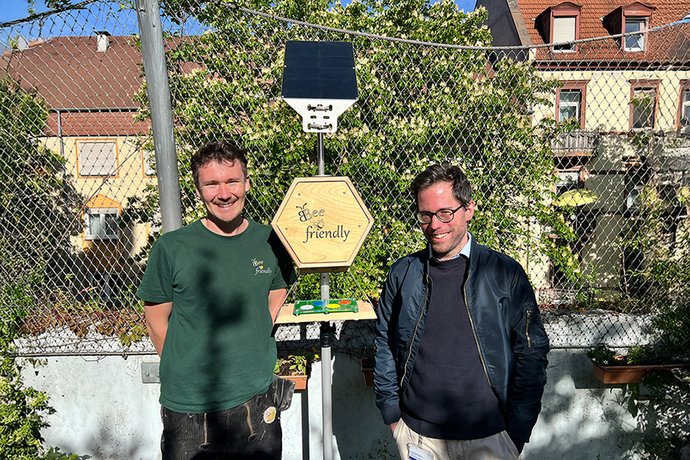
The Central Institute for Mental Health (CIMH) in Mannheim is strengthening its commitment to a sustainable and health-promoting environment: By installing an AI-powered “Insector” to measure biodiversity in its rooftop garden, the institute is expanding its efforts to enhance the ecological quality of the campus. The data collected not only provides insights into species diversity but is also of interest for research into the connection between the environment and mental health.
Sustainable Campus Development in Mannheim’s Westliche Unterstadt
The CIMH is dedicated to data-driven research, including studies on the impact of the environment on the human psyche. At the same time, the institute is actively committed to creating a people- and climate-friendly, livable environment in Mannheim’s Westliche Unterstadt. In addition to the use of solar energy, this includes a wide range of measures for greening and ecologically enhancing the campus in blocks J 4/J 5—from additional trees and green spaces to green roofs and the nature-oriented redesign of outdoor areas. These activities are also part of larger urban development initia-tives, such as the redesign of Swansea Square, which aims to enhance the quality of life and bring more urban greenery to the neighborhood.
The Insector records biodiversity
As part of its ongoing efforts, the CIMH has now installed a system to measure biodiversity in its rooftop garden. Between March and October, the “Insector”—developed by the nature conserva-tion startup Bee Friendly in Wiesloch—uses a solar-powered camera to record the insects present on site and document species diversity and abundance. The camera is focused exclusively on a land-ing pad, ensuring that no people or faces are captured. The Insector’s wooden housing was manu-factured at the Diakoniewerkstätten Rhein-Neckar, a facility that provides employment for people with intellectual and multiple disabilities. The Insector’s AI-powered analyses provide valuable in-sights for targeted conservation measures directly on campus. Through a publicly accessible dash-board, interested parties can also see which insect species are present in the rooftop garden and thus transparently track the development of biodiversity.
A Green Oasis for Patients
“With the Insector, we are adding another building block to our commitment to sustainability and biodiversity on campus and aligning it with the CIMH’s strategic goals: We are fostering a health-promoting environment while simultaneously generating valuable data for research. “Projects like this can only succeed through the dedicated collaboration of many departments within the institu-tion and in close cooperation with our partners from the city’s greening network,” says Dr. Malte Zimdahl, Advisor to the Director and Chairman of the Board at the CIMH.
The CIMH’s rooftop garden is much more than just a research site: it is a green oasis in J 5 of which the CIMH is particularly proud, as it is largely conceived, designed, and maintained by dedicated colleagues. Patients use it for relaxing breaks, help tend the plants, and grow herbs and vegetables, some of which are used directly on the wards. The diverse plant life, complemented by a small pond, creates a habitat for numerous insect species—whose activity the Insector now makes visible.
Green spaces promote mental health
The newly acquired data also opens up exciting prospects for research at the CIMH, particularly at the intersection of the environment, biodiversity, and mental health. “Green environments are not a luxury, but a key factor in our mental well-being—they promote relaxation, reduce stress, and strengthen resilience in the long term,” emphasizes Prof. Dr. Dr. Heike Tost. The psychiatrist, psy-chologist, and neuroscientist has been studying the effects of environmental factors on mental health for many years.