

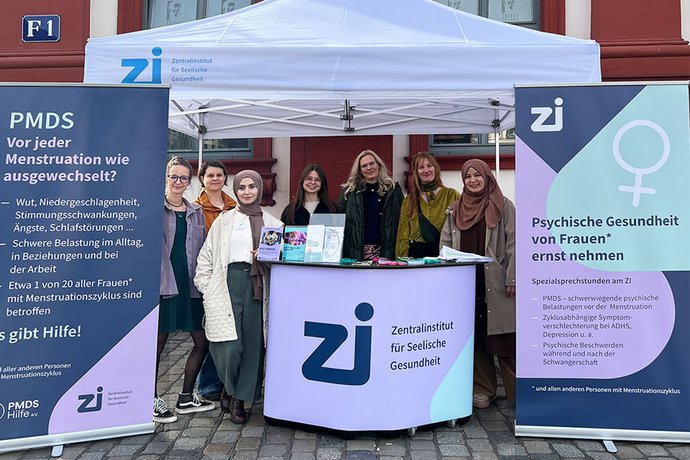
On International Women's Day, the CIMH provided information on mental health issues related to pregnancy, menstruation, and menopause at Mannheim's market square. Certain mental illnesses affect women exclusively. These include symptoms that occur regularly before menstruation and can be very distressing, as well as depression before and after childbirth. However, there is often a lack of information and education. Many affected women do not know what is happening to them and that help is available.
Information point at Mannheim Market Square
To raise awareness and promote women's mental health, experts from the CIMH and the PMDS Hilfe association answered questions and provided information at an information stand on Mannheim's market square on Friday, March 6.
Psychologists who offer diagnostics and counseling for women at the CIMH were on site, as well as the self-help association PMDS Hilfe e. V., which supports women suffering from premenstrual dysphoric disorder (PMDD). This neurobiologically induced reaction to hormone fluctuations, which occurs regularly before menstruation and causes great suffering, affects around five percent of all women with a menstrual cycle.
Making knowledge accessible
“Many women suffer in silence because psychological problems associated with hormonal changes during the menstrual cycle, around childbirth, or during menopause are often considered normal. However, there are treatment options available for these problems. Their suffering is not an individual fate that they must accept. That is why it is important to us not only to offer therapeutic support, but also to actively provide information and make knowledge accessible in an understandable way,” says Dr. Sibel Nayman from the Department of Psychosomatic and Psychotherapeutic Medicine, who diagnoses PMDD, advises affected women, and conducts research on this condition at the CIMH.
“I was also moved by the fact that partners and relatives came to our stand to pick up information material. One sentence that was said in passing but stuck in my mind was: ‘My partner says there’s no help available,’” reports Nayman.
Those who wanted to could use a poster to assess the intensity of symptoms over the course of their cycle. “The feedback ranged from no symptoms at all to very severe premenstrual symptoms — a picture that we are familiar with from research,” said Nayman.
At the same time, the stand also appealed to people who had general questions about psychological support services. “This showed once again how important it is to be present and approachable in public spaces in order to facilitate access and break down barriers to care,” says Nayman.
The information stand was made possible by donations from the CIMH’s Friends Association.
Treatment options at the CIMH
Spezialambulanz für Prämenstruelle Dysphorische Störung (PMDS)
Contact: Dr. Sibel Nayman
Appointment scheduling via the central outpatient clinic
zentralambulanz(at)zi-mannheim.de
Phone: +49 621 1703-2850
Ambulanz für psychische Erkrankungen in der Zeit um die Geburt
Contact: Dr. Maria Gilles
maria.gilles(at)zi-mannheim.de
More informations
PMDS Hilfe e. V.
https://pmds-hilfe.de